1

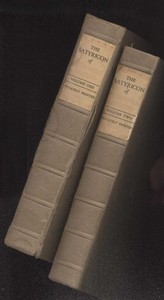
The Satyricon — Complete — A Reader’s Guide
3
1
Project Gutenberg
2004
Rome -- Fiction; Satire, Latin -- Translations into English
Readers of public-domain and historical texts
Project Gutenberg digital edition
en
Edition facts
Words: 102,213
Reading time: 445 min
Text sections: 12
Source:
Project Gutenberg record #5225
W. C. Firebaugh's translation of Petronius's Satyricon captures the novel's colloquial Latin through period slang, as seen in his preface's discussion of rendering 'bellum pomum' as 'he's a daisy' versus 'he's a peach.' The text includes Nodot and Marchena forgeries, and the storm scene (Ch. 114) showcases vivid, sensory prose.
Editorial Edition Score
4.9/5
★★★★★
★★★★★
Calculated from edition completeness, EPUB availability, text structure and catalogue metadata. Not a user rating.
Edition quality
W. C. Firebaugh's 1922 translation of Petronius's Satyricon is notable for its deliberate use of contemporary slang, a choice he defends in his preface by citing the ephemeral nature of colloquial speech. He contrasts Harry Thurston Peck's 1898 rendering of 'bellum pomum' as 'he's a daisy' with a more modern 'he's a peach,' acknowledging that no translation of the work's dialogue can be final. This editorial stance shapes the entire text, giving the characters' voices a deliberately dated yet vivid quality.
Slang as a Translational Strategy
Firebaugh's preface explicitly addresses the challenge of rendering the Satyricon's argot. He notes that 'the evolution of slang is rapid and its usage ephemeral,' and that a translation must be 'in the slang of the hour' to capture the original's tone. This is not a claim of authenticity but a practical choice: by using phrases like 'that was the life' for 'illud erat vivere,' Firebaugh aims to evoke the same immediacy Petronius's contemporary readers would have felt. The result is a version that feels both dated and energetic, a deliberate artifact of its own era.
The Storm Scene: Sensory and Structural Choices
In Chapter 114, the storm is rendered through a series of precise, sensory details: 'clouds, gathering from every quarter, obscured with darkness the light of day,' and a 'pall of such black density blotted out the light.' The helmsman loses his bearings, and the wind shifts unpredictably between Sicily and the Italian coast. Petronius builds tension through short, parallel clauses—'no mast, no helm, not a rope nor an oar remained'—before introducing the comic anti-climax of Eumolpus composing poetry below deck. Firebaugh's translation preserves this juxtaposition of mortal danger and absurd artistic preoccupation.
Dialogue and Emotional Register
The characters' speech in the storm scene reveals their distinct voices. Lycas, in panic, uses imperative, pleading language: 'Save us from destruction, Encolpius... Be merciful, for heaven’s sake.' Encolpius, by contrast, shifts into theatrical lament: 'Did we deserve this from the gods... to be united only in death?' Giton's response is practical and tender: he removes his garment, creeps under Encolpius's tunic, and binds them together with a belt. The dialogue moves between high emotion and concrete action, a pattern Firebaugh maintains throughout the translation.
Inclusion of Forgeries and Textual History
Firebaugh's edition incorporates 'the forgeries of Nodot and Marchena, and the readings introduced into the text by De Salas.' This is not a claim to a pure or authoritative text; rather, it acknowledges the fragmentary state of the Satyricon and the long history of scholarly interpolation. The preface discusses the need for revision when 'fresh manuscripts had improved the text,' but here the additions are presented as part of the work's reception history. Readers encounter a composite version that reflects centuries of editorial intervention.
Firebaugh's translation invites readers to consider the Satyricon as a work in progress, shaped by both its ancient origins and its modern interpreters. The slang choices, the vivid storm sequence, and the inclusion of forgeries all point to a text that resists finality. Approaching it as a layered artifact—rather than a fixed original—allows for a richer engagement with Petronius's satirical world.
Reader reflection
What did you think of this book?
Answer a few questions and save a private reflection on this device.
Your progress
0
/
10
2
Did this book hold your interest?
3
How likely are you to recommend this book?
4
How demanding did the text feel?
5
Would this book work well in a reading group?
6
Did you relate to its people, ideas, or situations?
7
How valuable was this book for your own interests?
8
Which element worked best for you?
9
What changed or sharpened your thinking?
10